The Draft EU Public Procurement Regulation 2026
The EU Directive 2014, UK Procurement Act 2023 and the implications of proposed reform for public buyers and suppliers
In this briefing
Introduction
The European Commission’s proposed Public Procurement Act, published on 9 September 2026, is a proposed Regulation intended to replace three directives governing public contracts, utilities and concessions. It addresses a market worth roughly €2.5 trillion in public purchasing each year, but the significance of the proposal extends beyond the value of contracts advertised. Procurement is increasingly being asked to deliver industrial resilience, secure technology supply, environmental progress and fair access for smaller suppliers, while remaining competitive and administratively workable.
The present framework rests on Directives 2014/23/EU, 2014/24/EU and 2014/25/EU, which Member States have transposed into domestic law. Shared EU principles therefore operate through different national statutes, procedures, institutions and purchasing systems. A directly applicable Regulation would establish a common legislative text across 27 countries. It would not remove differences in administration, supplier markets or enforcement, and the legislative proposal itself may change materially during negotiation.
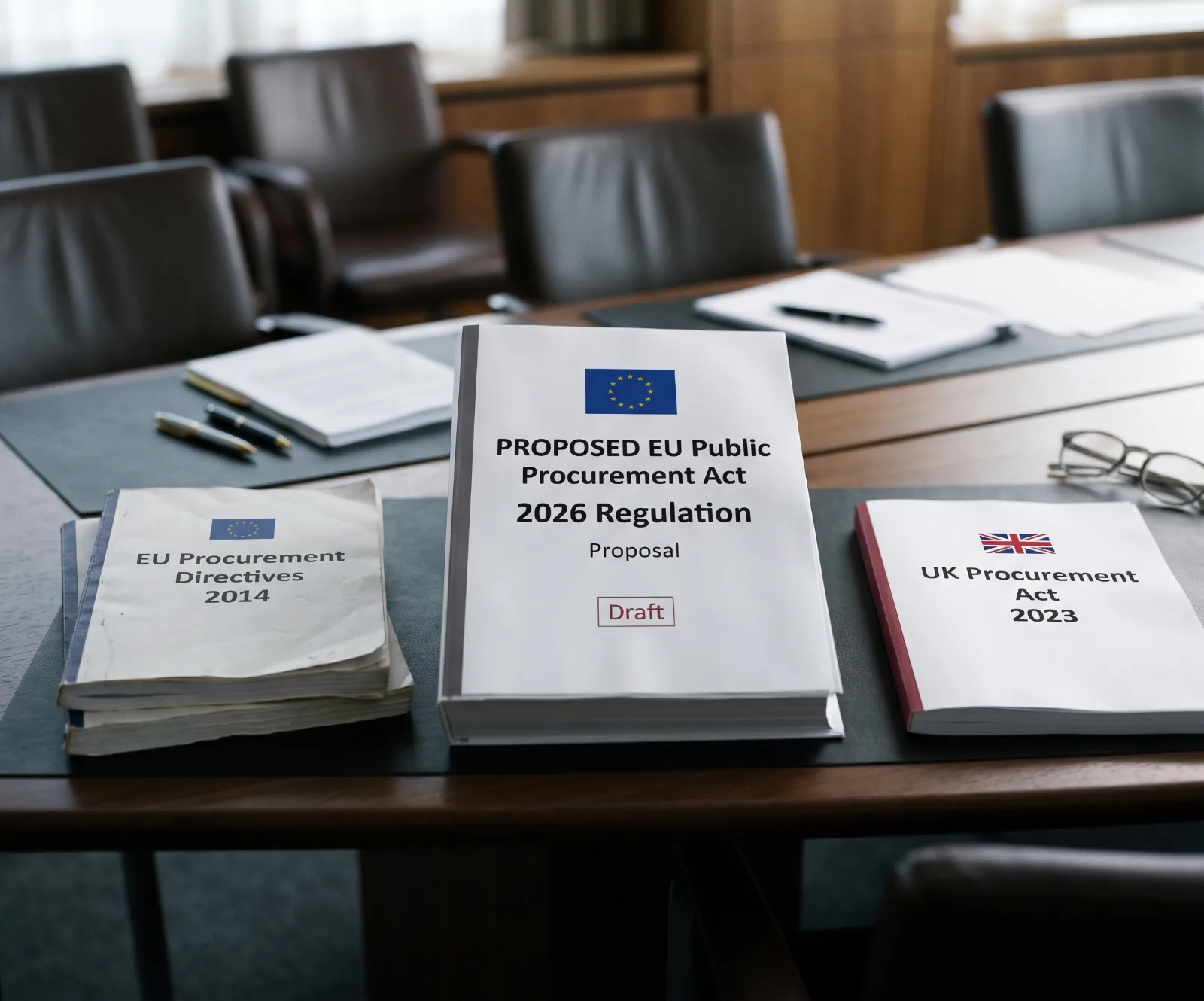
This ten-part series reads the Commission’s proposal against two practical baselines: the EU rules in force today, and the UK’s Procurement Act 2023, which replaced much of the Public Contracts Regulations 2015 architecture in February 2025. The UK comparison helps identify choices about flexibility, supplier qualification, contract notices and digital implementation. It is an analytical comparison, not a suggestion that the EU and UK have identical obligations or implementation challenges.
What the proposed Regulation would change
Consolidation is the starting point, but procurement teams would experience the reforms as a series of connected decisions. Who is entitled to compete, what evidence buyers may require, when and how negotiation can take place, whether origin-based preferences are applied, and how quality should be measured all affect the market that receives a tender. The proposal also reaches further into performance after contract signature through framework agreements, contract modifications, termination and publication duties.
A second strand concerns public procurement as an instrument of wider European policy. The draft provides mechanisms for European preference, innovation procurement and security screening, alongside environmental, social and accessibility requirements. These provisions operate at different stages of the purchase. Their interaction matters: a supplier might be eligible to bid but face distinct origin conditions, technical specifications, award criteria and contract-performance obligations.
The final strand is implementation. The Commission envisages shared electronic eligibility, interoperable procurement systems, national data spaces and Union-level reporting. Those systems are central to the projected reduction in administrative effort. The regulatory and technical timetables are therefore intertwined, while the Commission’s impact-assessment figures remain forecasts, not demonstrated savings.
The ten-part briefing programme
Part 1 — One Regulation, Not Three: Establishes why the Commission is proposing direct application rather than another set of directives, the sectors covered, the limits of legislative uniformity, and the lessons and differences arising from the UK consolidation. It also sets out the status and timetable of the draft.
Part 2 — Who’s In, Who’s Out: Examines mandatory and discretionary exclusion grounds, supplier ownership and key-person scrutiny, financial standing and technical capacity. The commercial question is whether stronger integrity requirements can coexist with proportionate selection tests that allow SMEs and first-time bidders genuine access.
Part 3 — Four Ways to Buy: Explains the proposed open, dynamic and innovation procedures, alongside exceptional direct awards. It considers how negotiation would operate inside ordinary tendering, what buyers must fix in advance, and how these choices affect bidder effort, competition and evaluation.
Part 4 — Buying European: Examines the proposed European-preference rules, including international trade agreements, supplier origin, European content requirements and the Commission’s powers to introduce restrictions. It considers the implications for international suppliers, market access, supply chain strategy and competition in EU public procurement.
Part 5 — Innovation and Security in the Room: Covers the general Regulation’s innovation procurement techniques, intellectual property position and scrutiny of suppliers providing sensitive or critical capabilities. It distinguishes innovation procured under this framework from standalone R&D services addressed in the companion European Innovation Act proposal.
Part 6 — Green and Social by Design: Examines environmental and social procurement objectives, product-specific sustainability obligations, circular purchasing, accessibility, supported employment and health and social services. The briefing considers which provisions would create binding purchasing conditions and which would leave choices to contracting authorities.
Part 7 — Award Criteria and the Quality Question: Analyses the proposed best price-quality ratio approach, minimum quality weightings, life-cycle costing and contract lotting. It tests what the rules could mean for commodity purchases, labour-intensive services, evaluation resources and suppliers competing on value beyond price.
Part 8 — Contracts in Motion: Turns to framework agreement design, unusually low tenders, modifications during performance and termination. It addresses the commercial importance of properly drafted adjustment clauses, clear procurement routes for changes, and maintaining the legality of a contract as requirements evolve.
Part 9 — The Digital Backbone: Assesses electronic eligibility credentials, interoperability between national systems, procurement data spaces and monitoring arrangements. It connects transparency and potential fraud detection to practical questions about data quality, supplier registration and the readiness of public technology infrastructure.
Part 10 — Costs, Savings and Implementation Timetable: Brings the series together through the Commission’s impact assessment, forecast administrative savings, implementation costs and legislative timetable. It distinguishes projection from evidence and identifies what buyers, suppliers and investors will be able to measure only after adoption and operation.
What this means for commercial decisions
For contracting authorities, the immediate task is to understand the direction of the proposal without rewriting procurement policy prematurely. Procurement strategy, supplier qualification, commercial negotiation, evaluation and contract terms all potentially change, but only final legislation can establish binding future requirements. The design of tender data, contract management systems and workforce capability may require longer preparation than changing a standard notice or procedure name.
For businesses selling to public buyers, the reform raises connected questions about access, evidence, bid cost and commercial positioning. A supplier may need to review group structure and exclusion-screening information, reliance on subcontractors, country-of-origin exposure, ability to substantiate quality and environmental claims, and its treatment of intellectual property. International suppliers should test those questions against the actual procurement and the Union’s trade commitments rather than assume a single rule for every market.
For investors and companies evaluating European public-sector revenue, the draft could affect the economics of market entry, supplier qualification, contract retention and technology dependence. It also underscores why due diligence must distinguish announced policy from enacted obligations and potential commercial impact from realised financial outcomes.
Legislative position and access to the series
This overview considers the Commission proposal published on 9 September 2026, not an Act already in force. The European Parliament and Council may amend the content, legal drafting, dates and accompanying powers before adoption. All provisions discussed in the series should therefore be read as proposals unless expressly identified as current law.
About the Author
CPO Insights is a market intelligence and thought leadership service of Ipso Facto Consulting Limited. Drawing on founder Ajay Channana's more than 20 years of experience across the public and private sectors, its briefings examine market dynamics, competitive landscapes and their impact on procurement strategy, commercial decisions and supply chain risk.
Ipso Facto Consulting provides independent commercial and procurement advisory services, including fractional procurement leadership, technology and digital procurement, commercial due diligence and UK public-sector market access. The firm supports established organisations with procurement transformation and commercial strategy; private equity and venture capital investors with investment and acquisition due diligence; and founders, start-ups and scaleups with funding readiness, commercial growth and UK market entry.
Disclaimer
This briefing draws on published sources, market insights and the author's commercial experience. Where individual company figures are cited, they are attributed to their original sources. While the text may reference specific organisations, public bodies, departments, products or services, this does not imply endorsement. The briefing is provided for general information and discussion only. It does not constitute legal, financial, investment or other professional advice and should not be relied upon as such. Readers should seek independent specialist advice appropriate to their circumstances before acting on any matter discussed herein.
This briefing reflects the author's analysis and understanding of the market, based on professional experience and information available at the time of publication. It is provided for information and discussion and is not legal, financial, investment or other professional advice. Full disclaimer.